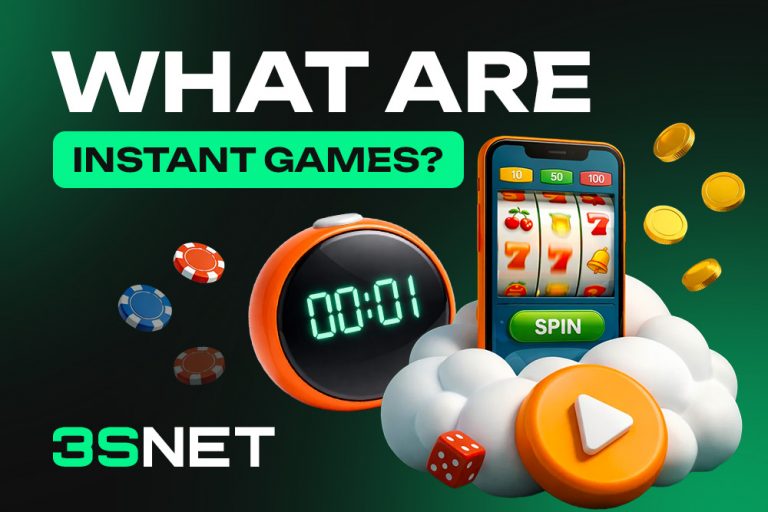
What Are Instant Games?

All the details about instant games in online casinos — a format of quick bets with a timer.

Publication date: 25 February 2026

Instant games represent a format where you get the result immediately. You press a button, swipe, scratch off a “layer” and instantly see whether you’ve won or lost, with no lengthy gameplay or waiting for a draw. In online casinos, these are often called instant win games or iNSTANTS: simple mechanics, fast rounds, minimal effort on your part, and maximum instant payoff.

What Do We Mean by Instant Games?

Instant Games are a category of video games that you can play instantly, without the need to download or install anything. This term has two main meanings, associated with major technology companies: Facebook and Google.

In a broader sense, the term “instant game” can also refer to hyper‑casual games — simple games you can play for a minute and then forget about.

Facebook Instant Games*

This is the best-known form of Instant Games. Facebook* launched this feature in 2016, allowing users to play games directly in Messenger and the Facebook* news feed.

  • Technology: The games are built on HTML5 technology, ensuring cross-platform compatibility and the ability to play without navigating to other websites or downloading apps.
  • Key Feature: The main focus is on social interaction. You can challenge friends, compete with them on leaderboards, and share your results.
  • Launch Titles: At launch, 17 classic games were available, including Pac-Man, Space Invaders, Puzzle Bobble (Bubble Bobble), and others.

Google Instant Games

In June 2022, Google also launched a standalone Android app called Google Instant Games.

  • Technology: As with Facebook*, this is a platform for HTML5 games.
  • Key Feature: It is a standalone aggregator app that gathers hundreds of mini-games in one place. Its main selling points are “play without downloading” and the ability to play offline (in some games).
  • Games: It includes titles such as Om Nom Run (from the creators of Cut the Rope), Stack Bounce, chess, billiards, and many other casual games.

What does “instant” mean? In this context, “instant” is about getting results immediately. The game gives you an outcome literally seconds after a click or a swipe. There’s no waiting for a draw, no lengthy levels, and no complex strategies. Each bet or session concludes right away, making the format perfect for short sessions and quick emotional payoffs.

How Do Instant Games Work?

At their core, instant games rely on randomness and very simple logic. Typically, everything is built around a random number generator (RNG), which determines the outcome of each attempt independently of previous ones. You reveal symbols, press a button, make one spin or play one “line”. The game immediately delivers the result, without complex multi-step processes or intricate bonus mechanics (though many instant slots do include features like cascading reels, multipliers, and mini-games).

Instant Games can be understood in two ways:

  1. As a specific product: platforms from Facebook* and Google that feature HTML5 games for instant play.
  2. As a type of game: a trend toward lightweight, social games that require no installation.

The Pros and Cons of Instant Games for Players and Operators

Instant Games are a double-edged sword. On one hand, they open up gaming to millions of new users who were previously shut out by technical or mental barriers. On the other hand, they pose complex challenges for creators: how to monetize them and how to avoid drowning in a sea of repetitive content. Success here depends on whether the platform can strike a balance between accessibility and quality, and whether the developer can offer a truly engaging mechanic within those first five seconds.

Advantages

Instant games deliver a quick “dopamine hit” to players and provide operators with a solid boost in engagement and monetization. That’s why they’re being pushed so aggressively online.

1 of 2
  • For Players

    For the player, the main appeal is speed and simplicity. Instant games deliver results in seconds, with no complicated rules or lengthy sessions: press, reveal, get the outcome. This makes them perfect for short bursts (on a break or on the go) when there’s no desire to dive into complex mechanics. Research on fast-paced and casual games shows that this format holds attention, provides a constant sense of action, and resonates well with a mass audience looking for something “quick, simple, and straightforward.”

    The second perk is a sense of control and engagement. In many instant games, the player’s input still matters: tapping at the right moment, choosing a cell, adjusting the force of a hit. This creates the feeling that you influence the outcome, rather than just watching an autospin. Moreover, operators often offer separate bonuses tailored to instant games (free spins, no-deposit bonuses, cashback, prize wheels) adding an extra layer of freebies and motivation to jump into this particular section.

    Read more
  • For Operators

    For operators, instant games are a tool for boosting engagement and retention. Short, easily repeatable sessions increase the frequency of visits: a user can click through a few rounds several times a day, and research on casual games shows that this very format (short, regular sessions) leads to higher long-term retention.

    The fast format aligns perfectly with promotions: free rounds, instant draws, fortune wheels, and other “one click, one result” mechanics are easy to integrate into bonuses, campaigns, tournaments, and warm‑up sequences. Plus, instant games widen the funnel by attracting more casual users who might find classic slots or poker too complex, while simple tap‑to‑win mechanics feel like light entertainment.

    Finally, instant feedback and the short cycle provide more predictable economics. With a high frequency of rounds, operators gather statistics on RTP, hit rates, and player behavior more quickly, allowing them to test settings, bonuses, and UX more efficiently and fine‑tune the product to their audience.

    Read more

Disadvantages of Instant Games for Players and Operators

Instant games deliver a quick thrill, but it’s precisely because of their speed and simplicity that they come with plenty of hidden pitfalls, for both players and operators.


1 of 2
  • Disadvantages for Players

    The main drawback for players is the risk of burning through their bankroll too quickly. Research on the harmful factors of gambling specifically highlights products with a high event frequency: the shorter the gap between bets and results, the higher the risk of impulsive behavior and “just one more spin.” In instant games, the “desire → bet → result → new bet” cycle is compressed into seconds, and bets of 1–2 units across dozens of attempts per session quickly add up to significant amounts.

    The second risk is the reinforcement of problem behavior. Reports on the risks of online slots and instant products show that fast, repetitive, and purely chance‑based games are more frequently associated with gambling harm. People prone to “chasing losses” are more likely to go on extended attempts to win back money precisely where rounds end instantly. Added to this is 24/7 online access, there are no natural pauses, unlike with offline lotteries or betting on rare events.

    Another downside is the illusion of a light game. As instant games are simple and resemble casual mini‑games, some players underestimate the risks. They perceive the product as light entertainment, even though the mathematical expectation is the same as in other casino games. This can be particularly dangerous for young users and those who frequently play casual games. The line between a game and a bet becomes blurred.

    Read more
  • Disadvantages for Operators

    For operators, the main risk is regulatory pressure. Regulators increasingly associate high speed, event frequency, and instant wins with an elevated risk of harm, requiring such products to be restricted, by introducing minimum time between rounds, bet limits, pauses, and additional protective measures. Some reports explicitly state that instant games and online slots may require stricter limits than other products to offset their risk profile.

    The second issue is reputational risks and increased scrutiny regarding CSR/Responsible Gambling. Reports such as those from GambleAware show that fast online casino games and electronic terminals are more strongly associated with harm and are more frequently the focus of public campaigns. This can lead to additional audits, ad restrictions, and negative media coverage if a brand pushes the instant format too aggressively.

    Finally, from a business perspective, instant games can “burn through” players. With excessively high intensity, some users quickly burn out or have a negative experience and leave, reducing long‑term LTV and increasing the pressure to acquire new players. Combined with high acquisition costs, this makes operators more vulnerable. If responsible gambling mechanics aren’t embedded into both the product and marketing, they risk facing both regulatory scrutiny and weak long‑term economics.

    Read more

How Have Instant Games Impacted the iGaming Industry?

The instant format has significantly shaken up the niche of fast digital entertainment: from online casinos and lotteries to lightweight HTML5 games in social networks and messengers. The value proposition is simple: the player doesn’t need to learn anything, install an app, or spend much time. They can jump in for a couple of minutes, get an emotional payoff and leave.

This is clearly visible in the example of social networks. When Facebook* launched Instant Games on HTML5, developers gained a platform where they could run simple, instantly accessible games directly inside Facebook* and Messenger, without the need to download a native app. This format became an additional source of user engagement and a separate monetization stream for devs. Facebook* initially shared revenue 70/30 in favor of the developer.

The instant format works best for:

  • Instant lotteries and scratch‑offs;
  • Simple slots with fast spins and frequent hits (instant win slots);
  • Mini‑arcades with a single intuitive action: tap, throw, shoot (basketball, shooters, simple runners);
  • Pick‑and‑win games: choose a cell, reveal a symbol, see the result instantly.

Genres that rely on long-term progression, a storyline, or complex strategy are less suited to the instant format, as they break the “one click, one result” concept.

One standout case from Facebook* Instant Games is Basketball FRVR: a very simple 3‑point shooter that, at the time of writing, had surpassed 4.2 billion games played and was on track to achieve seven‑figure annual revenue from advertising alone. In the online casino world, instant win slots and iNSTANT lotteries have their own set of “stars” that regularly appear among major providers, though the specific “top lineup” ultimately depends on each individual operator.

In online casinos, instant games most commonly refer to instant win games, where you take an action and immediately see the result without lengthy spins, rounds, or complex rules. These can be standalone titles or entire collections under instant/quick games sections in the casino lobby.

  1. Scratch Cards and Instant Lotteries

Scratch cards and digital lotteries are the classic instant win format: “buy a ticket → scratch off the layer → immediately see if you’ve won or not.” In online casinos, these are virtual cards where you click to scratch off the protective layer and instantly get the result.

Popular examples in this segment (names may vary by operator):

  • digital scratch cards with fixed fields (classic “match 3 symbols” mechanics);
  • instant number lotteries and keno, where the draw and payout happen immediately after selecting numbers.
  1. Instant Win Slots and “Instant Slots”

Many modern slots effectively behave like instant games. A single spin takes seconds, the result is displayed immediately, and gameplay can be sped up with autospins. Popular fast slots often cited as examples of instant games include:

  • Starburst: a very simple slot with quick, short rounds and frequent small wins;
  • Gonzo’s Quest and its variations: thanks to cascading reels and rapid falls, rounds flow one after another without long pauses;
  • Progressive jackpot slots like Mega Moolah: they also deliver an instant result with each spin, while the jackpot builds in the background.

Formally, these are standard video slots. But for the player, they feel instant, especially on turbo spin.

  1. Dedicated Instant Games (Tic Tac Toe, LuckyTap, Plinko, etc.)

There is a separate class of games designed specifically as instant win: ultra‑simple mechanics, one click — one outcome, rounds lasting 5 to 30 seconds.

Typical examples:

  • Tic Tac Toe Games by Mascot Gaming: minimalist tic‑tac‑toe‑style games where a round takes seconds and the bet resolves almost instantly;
  • LuckyTap by Design Works Gaming: you bet, tap to “reveal” an element, and immediately see the win — no reels or lengthy animations;
  • Plinko: a digital version of the “coin drop” game: choose where to “drop” the chip and watch in seconds which multiplier it lands in.

Such games are often placed in dedicated sections like instant/arcade/fast games.

  1. Fast Arcade and Mini Casino Games

Some arcade and show‑style games, even if not always explicitly labeled as Instant Games, effectively operate in this format: one short round, instant settlement, the bet is resolved here and now. These include:

  • instant mini‑games in live casinos and game shows (various “wheel” variations, quick rounds, mini‑draws);
  • fast arcade games with a single click/throw (pachinko‑style, penalty/football mini‑games) where the outcome is decided within seconds.

To sum up: popular instant games in casinos include scratch cards and digital lotteries, fast slots, as well as dedicated instant win titles like Tic Tac Toe Games, LuckyTap, and Plinko — all of which compress the entire gambling experience into one or two seconds of feedback.

How Do Instant Games Differ from Other Formats?

The difference between instant games and other formats isn’t just a technical detail. It’s a fundamentally different approach to user interaction. They change the game where traditional formats require installation, time to learn, and powerful hardware.

Comparison of Instant Games with Other Gaming Formats 

Parameter Instant Games (Instant Win) Classic Slots Table Games (Roulette, Blackjack, etc.) Sports Betting
Round duration Seconds, result immediately after a click Short spin, can be sped up with autoplay Longer: bets, dealing, multiple player actions Minutes to hours, depending on the event duration
Event frequency Very high: dozens of rounds in a few minutes High, but usually slightly lower than in instant games Medium: pauses between rounds Low: limited by the sports calendar
Complexity of rules Minimal, “click — see result” Simple basic rules, but with bonus mechanics Higher: need to understand rules, strategy, bet types Higher: need to understand bet types and teams
Onboarding for beginners Very low entry barrier, similar to casual games Easy to moderate, visuals help Moderate to difficult for a complete beginner Moderate to difficult, requires interest in sports
Speed of bankroll consumption Very high due to round frequency High, but usually slightly more “stretched out” Lower: fewer rounds per unit of time Relatively low: few events per unit of time
Risk of impulsive play Maximum, the “bet → result → another bet” cycle is compressed High Medium Lower: more time for reflection
Depth of gameplay Low: focus on instant emotional payoff Medium: bonuses, free spins, visual effects High: strategy, decision-making in each hand High: analysis of matches and statistics
Time commitment required Minimal, suitable for very short sessions Short to medium sessions Medium to long sessions Often long: before and during the event
Suitability for long play sessions Not really, players quickly tire or burn through their bankroll Yes, at moderate speeds Yes, due to strategy and pace Yes, if interested in sports and analytics
Regulatory scrutiny Elevated (high‑frequency products are considered riskier) High High, but with less focus on frequency High, but with a different risk profile

To understand the difference, it’s easiest to compare the key characteristics of instant games with three main categories: classic mobile games (native apps), hyper‑casual games, and crash games, which are often confused due to their speed.

  1. Integration into the Social Environment, Not the Device
    This is perhaps the most important distinction. You don’t play in an app on your phone, you play within Facebook*, Messenger, Telegram, or Snapchat. This means the game is always at hand, right where your friends are. Retention in such games isn’t built on push notifications (which you don’t have) but on social interaction. A friend challenged you, shared a result, or invited you to play together.
  2. Extreme Simplicity of Entry and Exit
    While native games require commitment from the user (time spent on downloading and learning), instant games are designed for ultra‑short sessions and zero entry barriers. You play for 30 seconds and return to the chat. This is comparable to hyper‑casual games, but unlike them, instant games come with built‑in social elements that encourage you to come back again and again.
  3. Technological Lightness vs. Performance
    Instant games built on HTML5 may fall short of native games in graphics and complexity, but they run on any device (even the weakest ones) and on slow internet connections. This makes them ideal for emerging markets (Tier 2 and Tier 3 countries), where people may not have powerful flagship phones but have a strong desire to play and socialize.
  4. Monetization as a Reflection of the Platform
    Unlike the stable monetization model of native games, instant games are heavily dependent on the policies of the platform owner. For example, Facebook* was unable to implement in‑app purchases on iOS for a long time due to Apple’s rules, forcing developers to rely solely on advertising.

How Do Instant Games Differ from Crash Games?

Instant games and crash games are both about fast action, but they work differently and engage the player in different ways.

To put it simply: instant games are “click → see the result immediately,” while crash games are “click → watch the multiplier grow and decide when to cash out.”

Here are the key differences.

  1. Mechanics and Player Role
    In classic instant games (scratch, Plinko‑style, Tic Tac Toe, LuckyTap, etc.), you essentially take one simple step: place a bet, click/reveal a cell, and instantly get the result. The “magic” lies in the RNG. Your choices are limited to how much to bet and whether to play again.
    In crash games, there’s an active timing decision: the multiplier increases in real time, and your task is to click cashout before the crash. The math is still random, but the feeling of control and “I’ll make it / I won’t make it” is much stronger.
  2. Visuals and Round Dynamics
    Instant games follow a very short, fixed cycle: 5–30 seconds, minimal animations, the result is shown immediately.
    In crash games, the round is built around a chart or object (a plane, rocket, etc.) that rises until it crashes. The visuals and anticipation are part of the emotional experience: you watch the multiplier climb, feel the tension, and decide when to cash out.
  3. Risk/Reward Profile
    Instant games typically have fixed or limited multipliers, a clear payline, and focus on frequent small wins and quick payouts.
    Crash games, on the other hand, offer multipliers that can theoretically go very high, so players come precisely for that chance to “catch x50/x100.” But the trade‑off is a high probability of not cashing out in time and losing the bet.
  4. Sense of Control and Skill
    Instant games feel purely random: you simply reveal the outcome, like opening a lottery ticket.
    In the crash format, the player has an illusion of skill. They choose the moment to cash out, compare themselves with others in the chat or leaderboard, and see others’ cashouts, creating stronger social proof and the “I can do that too” effect.
  5. Risk Profile and Engagement
    Both formats are fast and potentially risky, but in different ways:
  • Instant is about “many small rounds in a row” and quick bankroll depletion if bets aren’t controlled;
  • Crash is about emotional peaks, chasing “high multipliers,” and the pursuit of big x, which amplifies the tendency toward risky decisions.

In summary: instant games offer a maximally simple, casual instant mechanic, closer to scratch lotteries and mini‑games. Crash games are a separate subgenre with a multiplier and timing‑based decision, where the player feels they control the outcome, resulting in significantly heightened emotions and risks.

Are There Restrictions on the Use of Instant Games?

Any instant format operates within the rules of the platform and jurisdiction. In the case of Facebook* Instant Games, the following apply:

возрастные ограничения на доступ к определенным типам контента;

  • age restrictions for access to certain types of content;
  • requirements regarding privacy, advertising, and in‑app purchases;
  • prohibitions on certain types of content (including real‑money gambling, unless explicitly permitted and properly licensed).

In the case of instant win casino games and digital lotteries, additional requirements from local legislation come into play: licenses, age restrictions, responsible gaming mechanics, etc. Therefore, any product in this space must be developed and promoted with careful consideration of local regulations and the specific policies of each platform.

Are There Alternatives to Instant Games?

Yes, the instant format isn’t tied exclusively to Facebook*. There are several alternative directions:

  • Web‑based HTML5 games outside social networks: the same instant mini‑games that run in browsers on any website;
  • Mobile hyper‑casual and quick‑play games in the App Store and Google Play, designed for very short sessions;
  • Instant win games and digital lotteries offered by online casinos and national lotteries;
  • Gaming mini‑apps and casual games within messengers (Telegram, WeChat, etc.), where the logic is similar: quick entry, short session, instant result.

In essence, the instant format isn’t a single platform, it’s a trend. Players enjoy the “jump in — play — see the result immediately” model, as well as different platforms and genres are gradually adapting to fit it.

*The social network Facebook is blocked in Russia by court decision. 

Instant games are not just small games, they are a gaming layer on top of the social experience. If native games create a separate digital world you retreat into, then instant games are games that come to you in the chat. They sacrifice graphics and depth for instant access and social connectivity, capturing an audience that would never call themselves gamers but happily compete with a friend in a quiz or a simple arcade game.

FAQ

What are instant games?

Instant games are a format where you press a button, swipe, or “scratch off a layer” and immediately see the result, without lengthy levels or waiting for a draw. They are built on simple mechanics and RNG, offering a fast round and instant emotional payoff, making them perfect for short “just a couple of minutes” sessions.

How do Facebook* / Google instant games differ from casino instant games?

Instant Games from Facebook* and Google are HTML5 mini‑games that launch instantly within a social network or a standalone app, with no installation required, focusing on social features and casual gameplay. Casino instant games are instant win products (scratch cards, Plinko, LuckyTap, fast slots) where each bet delivers a result within seconds, while monetization follows the gambling model.

What are the main pros and cons of instant games for players?

Pros: instant results, simple rules, no need to download anything or spend time learning, the format appeals to a mass audience and feels like casual games. Cons: the very fast “bet → result → another bet” cycle increases the risk of impulsive decisions, rapid bankroll depletion, and underestimating the risks, especially among those who perceive such games as “harmless entertainment.”

Why are operators actively developing instant games?

Instant games increase the frequency of visits and sessions, integrate smoothly into bonuses, draws, and tournaments, attract a casual audience, and provide operators with quick feedback on the product and its economics. At the same time, the high speed and frequency of rounds require operators to pay closer attention to responsible gambling, limits, and UX to avoid burning out LTV and drawing unwanted regulatory attention.


How do instant games differ from crash games, and are there alternatives to them?

In instant games, you simply take an action and immediately see the result. They are closer to scratch lotteries and mini‑arcades. In crash games, the multiplier grows in real time, and you need to cash out before the crash. So, the emotions are tied to timing and the illusion of skill. At the same time, the instant format itself extends beyond specific platforms. It includes HTML5 mini‑games on websites, hyper‑casual and quick‑play games in app stores, instant win lotteries, and mini‑games within messengers — anywhere the logic is “jump in — play — see the result immediately.”

Did you like the article?

Share it with your friends via favorite social media

Read more

In 2026, there is no single best advertising format on Telegram, as effectiveness depends directly …

Nothing happens randomly in the iGaming industry. The best connections, deals, and trends emerge at …

By 2026, Telegram has established itself as a key platform for casino and betting promotion. …

In 2026, generating traffic for casinos and betting is no longer just about buying clicks. …

Ludomania is not a bad habit but a form of addiction. That is why player …

iGaming trends in 2026 show the online gambling industry moving beyond simple “browser casinos” toward …

Advertising in AI chatbots in 2026 has only formally “launched,” but in fact, it has …

The iGaming industry in 2026 stands as one of the fastest-growing segments of the digital …

In iGaming, an account manager is the ultimate “relationship and revenue driver,” the key person …

Sweepstakes casinos are online platforms that offer a casino-style experience, yet are not formally classified …