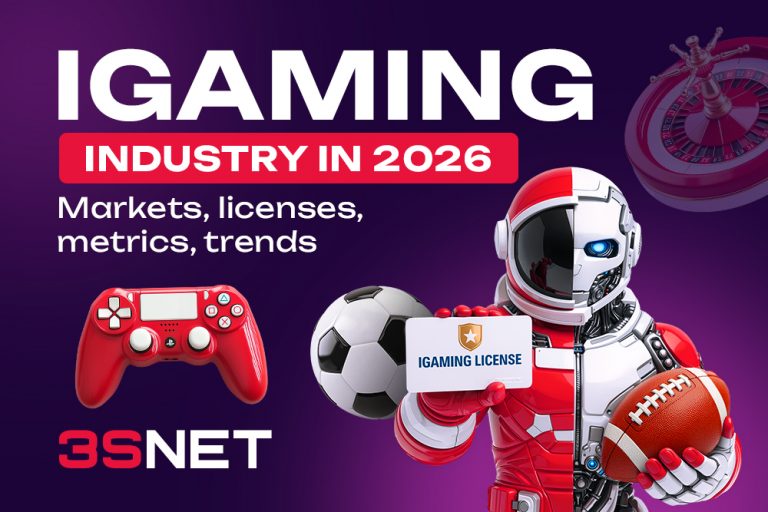

The iGaming Industry in 2026: Markets, Licenses, Metrics, Trends

The iGaming Industry in 2026: Markets, Licenses, Metrics, Trends

Publication date: 11 February 2026

The iGaming industry in 2026 stands as one of the fastest-growing segments of the digital economy.  The online casino and sports betting market continues to see double-digit growth, fueled by legalization, mobile traffic, and live-format engagement. By 2026, the global iGaming market is projected to surpass $100 billion in online revenue, with the gambling industry growth forecast through 2031 maintaining a steady CAGR of around 10–12%. The 3S.INFO study is tailored for media buyers, affiliate managers, project founders, and investors seeking a clear understanding of how the iGaming landscape operates: key gambling markets and jurisdictions, licensing options and their costs, core betting metrics, and the iGaming trends defining 2026.

What Is the iGaming Industry?

The iGaming industry refers to the entire online segment of the gambling sector: the market for online casinos, sports betting, poker rooms, online lotteries, and other real-money games accessed via the internet and mobile devices. The betting industry is a subset of iGaming focused on sports and event wagering (including sportsbooks, live betting, and esports) while the broader iGaming market also encompasses slots, live casino, and social formats.

The key difference between iGaming and traditional gambling or betting lies in its digital infrastructure and global reach. Operators serve multiple countries, relying on online payments, offshore gambling licenses, and regulated online casino frameworks, while the entire economics are built around performance marketing and betting metrics. Driven by smartphone penetration and 5G, iGaming is one of the fastest-growing digital sectors, with the online gambling market forecast to maintain double-digit growth through 2030–2035.

The iGaming Industry Structure

The iGaming industry comprises several core stakeholder groups:

  • Operators (bookmakers and online casinos): brands accepting sports bets and offering casino products, handling risk, pricing, promotions, and marketing.
  • Software and game providers: slot studios, live casino developers, sportsbook platform suppliers, and hosting solutions that deliver content and technological infrastructure.
  • Payment systems: acquirers, e-wallets, crypto providers, and aggregators, without which deposits and payouts in online casinos and sports betting would be impossible.
  • Affiliate networks and media buyers: affiliate programs and media buying teams that drive traffic via CPA/RevShare and work with betting KPIs: FTD, RGD betting conversion, LTV.
  • Regulators and licensing authorities: gambling commissions (Malta, Curaçao, local regulators) that define gambling jurisdictions, licensing requirements, and compliance standards.

iGaming Market Size and Dynamics in 2026

According to Mordor Intelligence, the online gambling market size is estimated at approximately $101.45 billion in 2026, up from $91.63 billion in 2025, with a forecast of $168.7 billion by 2031 (a CAGR of around 10.7%). The iGaming market is growing faster than the offline segment, driven by player migration online and a higher frequency of gaming sessions.

Sports betting accounts for more than half of online revenue. In 2025, it represented approximately 52% of the market and is showing the fastest growth rate among all product segments. The online casino market (comprising slots and live games) contributes the remainder and often delivers higher LTV, helping offset the seasonality of sports betting.

Mobile gambling statistics indicate that in 2025, smartphone and tablet platforms already accounted for 53.65% of online gambling revenue, with the fastest growth projected through 2031 (a CAGR of approximately 13.6%). This makes the mobile-first approach a standard for both operators and affiliates.

Gambling and Betting: Regional Statistics

An approximate regional structure of the iGaming market in 2026 is as follows:

Region Market Size 2026 (USD billion) Growth Rate (CAGR, estimate) Key Trends
Europe 38–40 6–8% Strict online casino regulation, rising taxes, stronger emphasis on Responsible Gambling.
North America 25–28 11–13% Sports betting legalization in the U.S., active iGaming market in 2026, mobile-first approach, live betting.
Asia–Pacific 18–20 12–14% Growth of offshore operators, crypto gambling, rising interest in esports and live formats.
Latin America 8–10 13–15% Legalization in Brazil and neighboring countries, rapid growth in football betting and casinos.
Rest of the World 5–7 5–7% Niche markets in Africa and the Middle East, expanding mobile access.
  1. Mobile-First Approach. Operators are restructuring their products around mobile-first principles: fast-loading lobbies, adaptive design, instant deposits, biometric login, and seamless one-tap sports betting and casino experiences.
  2. Live Betting and In-Play. The live betting market is outpacing pre-match growth: micro-betting, betting parlays, in-play marketing, and live-stream integration are making the product more dynamic and driving turnover.
  3. Esports Betting continues to gain share, particularly among younger audiences and in Asia. Operators are launching dedicated esports verticals and tailored bonuses.
  4. Cryptocurrency and Blockchain. Cryptocurrency gambling is becoming standard. Crypto deposits, loyalty tokens, and provably fair games attract a global audience and streamline operations for offshore operators.
  5. Gamification and Social Features. Missions, daily challenges, levels, tournaments, and social functions boost engagement and LTV, transforming gambling into a hybrid of gaming and social media.
  6. AI and Personalization. AI powers game recommendations, dynamic bonuses, fraud detection, risk management, and personalized player limits, as well as Responsible Gambling initiatives.
  7. Responsible Gambling. Requirements are tightening around self-exclusion, deposit limits, behavioral monitoring, and player education, especially in the EU and regulated markets.
  8. Market Consolidation and M&A. Tax pressures and complex regulations are fueling M&A activity. Major holding companies are acquiring local operators, while smaller players retreat into niches or shift under offshore gambling licenses.

iGaming Licensing and Regulation: The Purpose of Licenses

A gambling license is the foundation of an operator’s legal presence in target markets. It certifies compliance with online casino and betting regulations, covering game fairness, KYC/AML and Responsible Gambling standards.

Why a license is needed:

  • Legality and protection: reduces the risk of blocking, fines and criminal liability;
  • Player and operator safeguards: ensures fair play standards, dispute resolution, media buying;
  • Access to payment systems and banks: most PSPs and financial institutions only work with licensed operators;
  • User trust: a license badge boosts CR and LTV, especially in Tier 1 markets;
  • Advertising eligibility: without a license, promotion on search engines, social media, and mainstream media is typically prohibited or heavily restricted.

License types:

  • White-label / Regulated (Offshore): licenses issued by EU countries, the UK, or individual U.S. states. They offer a high level of trust and regulatory credibility but require strict compliance.
  • Gray zone: licenses or schemes in jurisdictions with looser online casino regulation or frameworks designed for external markets; operators serve foreign GEOs under moderate compliance requirements.​
  • Offshore: licenses from jurisdictions such as Curaçao, Curaçao‑like islands, and select Caribbean nations. These allow global operations with lower costs and fewer compliance burdens.

Offshore Licenses: Definition & Purpose

Offshore gambling and betting licenses are issued by jurisdictions that allow operators to conduct business internationally with lower costs and lighter regulation.

Types of offshore licenses:

  • Sub-license Model (Old Curaçao): Operators obtained a sub-license from a master licensee. Low cost, fast setup, but limited transparency and indirect oversight.
  • Full Offshore Licenses (New Curaçao, etc.): Direct B2C and B2B licenses issued by the regulatory authority. Fixed fees, basic compliance obligations, and greater regulatory clarity.
  • Unlicensed operators: Operate without a license, typically confined to high-risk GEOs and accompanied by the risk of blocks and issues with PSPs.
+
Low entry barrier and relatively affordable casino license cost;

GEO and product flexibility;

Fast launch and the ability to test new markets.

Lower reputation among banks and payment providers;

Advertising restrictions in regulated countries;

High exposure to shifts in international regulatory frameworks.

Who Should Consider an Offshore iGaming License?

  • Startups entering the iGaming industry;
  • Operators working in gray zones or targeting .com traffic;
  • Projects testing new GEOs and verticals before committing to stricter licenses.

iGaming Regulation and Compliance

Online casino and sports betting regulation is tightening, especially across Europe and parts of North America. 

Key Elements of iGaming Compliance

  • Responsible Gambling: deposit limits, warnings, self-exclusion, monitoring of risky behavior.
  • KYC/AML: player identification, source of funds verification, reporting of suspicious transactions.
  • Underage Protection: age verification, advertising restrictions, interface design safeguards.
  • GDPR and Data Protection: handling of EU users’ personal data.
  • Advertising Restrictions: limits on formats, timing, and content; prohibition of aggressive promotions.

Primary Jurisdictions for iGaming Licensing

1 of 3
  • European Licenses

    The key standard is the Malta MGA license. It grants operators access to European markets, carries strong reputational weight, and ensures smooth integration with payment providers. Requirements include local presence, auditing, strict KYC/AML procedures, and regular reporting. Total annual cost of ownership for a mid-to-large operator can reach hundreds of thousands of euros.

    Beyond Malta, national licenses from the UK, Sweden, Denmark, Germany, and the Netherlands are also significant, each regulating its local iGaming market and advertising framework.

    Read more
  • Offshore Licenses

    Curaçao long served as the primary “offshore” hub for iGaming, but the licensing model underwent reform in 2025–2026 with the introduction of the new LOK system, offering direct B2C and B2B licenses.

    According to industry consultants, the cost of a Curaçao license under the new model is as follows: an application fee of approximately €4,500 and an annual licensing fee of around €47,000 for a B2C operator, excluding infrastructure, legal, and compliance expenses. This remains significantly cheaper than a full MGA package and continues to be a popular choice for offshore gambling licensing.

    Read more
  • Emerging Jurisdictions

    Local licenses are gaining importance in Latin America (notably Brazil), specific Canadian provinces, select U.S. states, and several Asian and African countries opening their own iGaming markets. These jurisdictions are domestically focused, require a local legal entity, and often impose high tax rates. In return, they offer direct access to players and the ability to advertise through “white” channels.

    Read more

Comparison of Gambling and Betting Jurisdictions: Offshore, Local & Regional Options 

Jurisdiction Cost (Estimates) Time to Obtain Requirements Reputation Target Markets
Malta MGA From ~€25k/year + gaming revenue tax Months Strict KYC/AML, local office, auditing  High EU, select Tier 1 jurisdictions
Curaçao Application ~€4.6k, annual ~€47k (new model) Weeks to months Local representative, basic compliance Moderate .com, LatAm, Asia
Local licenses (U.S./EU) High fees, taxes on GGR Lengthy process Stringent regulation, reporting, local legal entity Very high Domestic markets 

What Is the Cost of a Betting License?

The cost of a casino or betting license depends on the chosen jurisdiction and the scale of the business. According to industry reports in 2025–2026:

  • Offshore setups such as a “Curaçao sub-license” under the old model typically cost around €18,000–25,000 per year in licensing fees, excluding operational expenses;
  • A full MGA license required approximately €25,000 in annual licensing fees, with large operators spending an additional €300,000–375,000 per year on compliance and tax payments;
  • The new Curaçao license (with annual fees around €47,000 plus application costs and compliance expenses) remains one of the most affordable entry points into the international iGaming market;
  • For local licenses in the U.S. or select EU countries, gambling license costs often include high one-time fees, mandatory deposits, and GGR taxes, placing the entry barrier even higher.

Which Countries and Markets Are Most Promising for iGaming?

In 2026, the best iGaming markets are shaping up around the U.S., Europe and Latin America.

  • The United States remains the primary driver of the sports betting and iGaming market: state-level legalization of sports betting and online casinos continues, the mobile segment is expanding, and interest in live betting is growing.
  • Brazil and Latin America: LatAm is transitioning from “emerging opportunity” to a core business pillar, particularly following the legalization of sports betting and online casinos in Brazil.
  • Europe is a mature but challenging region marked by strict regulation, where growth is driven by mobile gambling and product optimization aligned with Responsible Gambling standards.
  • Canada and select Asian markets: stable demand, high ARPU, and a strong mobile-first presence.

According to iGaming trends 2026 industry reports, the technology agenda is shaping up as follows:

  • AI and Machine Learning: offer personalization, fraud detection, risk management, and dynamic bonus pricing.
  • Blockchain and Provably Fair: crypto casinos, tokens, transparent draw mechanics, and verifiable game fairness.
  • VR/AR Casinos: experimental projects delivering immersive experiences and social features.
  • Biometrics and Verification: simplified login, enhanced security, and KYC compliance.
  • Cloud Gaming and 5G: reduced latency, large-scale live casino streaming, and match streaming for live betting.

KPIs & Metrics in iGaming & Betting

For operators and affiliates in 2026–2027, the following metrics are critical:

  • First Deposit Metrics (FTD): volume and cost of new users making their first deposit.
  • RGD Conversion (Betting): share of users who place their first deposit after registration; a key indicator of flow and traffic quality.
  • Betting LTV Metrics: player lifetime value, average revenue generated per player over their lifespan.
  • ARPU / ARPPU: average revenue per user / per paying user.
  • Retention and Churn: share of returning players, session frequency, length of active engagement.

For sports betting and casino ad campaigns, the following are also crucial: CTR, registration CR, FTD CR, and channel‑by‑channel performance against betting KPIs across different GEOs.

The Role of Mobile Apps in iGaming (2026–2027)

Mobile gambling statistics show that mobile devices have already overtaken desktop in revenue share and are expected to grow at a faster pace through 2031. Mobile-first platforms deliver:

  • higher registration and deposit CR through seamless UX and biometric authentication;
  • continuous engagement via push notifications and in-app messaging;
  • the ability to quickly promote live bets and parlays.

Key aspects of the mobile‑first approach:

  • App Store and Google Play impose stricter iGaming regulations, prompting some brands to develop region‑specific native apps, while others focus on web versions and PWA;
  • Progressive Web Apps (PWAs) enable operators to bypass store restrictions. Users get an icon and push notifications, while operators retain full control over updates and tracking.

Live Betting: Definition and the Story Behind Its Boom

Live betting (in-play) refers to wagers placed after an event has started and updated in real time. Unlike pre-match bets, live markets allow players to react to the flow of the game, place micro-bets, and build parlays dynamically.

Key growth drivers:

  • Technology: real-time odds, fast statistical feeds, live streaming, low-latency infrastructure.
  • Psychology: the “here and now” effect, a short feedback loop from wager to outcome, and the chance to chase losses or double down.
  • Product: dedicated live-betting sections, quick coupons, and one-click cashout.

Estimates suggest live betting now accounts for over 50% of total sports wagering turnover. Its share continues to climb, particularly on mobile.

Forecasting iGaming Evolution to 2030

According to medium-term forecasts, the online gambling market could exceed $150–170 billion in global revenue by 2030 and reach approximately $250 billion by 2035. Emerging markets (the U.S., Brazil, and select Asian countries) will serve as the primary growth drivers, while mature European markets stabilize under increasing regulatory pressure.

Products will evolve toward hybrid platforms that integrate sports betting, casino, esports, social features, and crypto functionality. Consolidation will continue, but alongside major holding groups, there will still be room for niche operators focused on specific GEOs or verticals. Affiliate marketing and media buying will remain critical growth channels, but only when paired with high-quality content, strict compliance, and betting KPI analytics at the individual traffic-source level.

iGaming Industry Challenges

Despite the positive growth forecast for the gambling and betting industry, the market faces significant challenges:

  • Tightening regulation and rising taxes in key jurisdictions;
  • Increasing complexity of anti-fraud systems and the fight against bonus abuse;
  • Payment restrictions and the withdrawal of certain PSPs from high-risk markets;
  • Affiliate marketing shifts: rising traffic costs, tracking and attribution limitations, SEO volatility;
  • Growing demands for social responsibility and mounting public pressure on the gambling industry


FAQ

What is iGaming and how does it differ from betting?

iGaming encompasses the entire online gambling sector: online casinos, poker, lotteries, and sports betting, all delivered via the internet and mobile devices. Betting is a subset of iGaming focused solely on wagers on sports and events, while iGaming covers the full range of gaming verticals.

Which countries lead the iGaming market by volume?

The largest shares of the iGaming market in 2026 are held by Europe and North America, particularly the UK, the Nordic countries, the U.S., and Canada. The fastest growth, however, is occurring in the U.S. and Latin America (notably Brazil), driven by the ongoing legalization of online casinos and sports betting.

Which trends will define iGaming in 2026?

Key iGaming trends in 2026 include the mobile-first approach, the rise of live betting, the expansion of esports betting, cryptocurrency integration, AI-driven personalization, and stricter Responsible Gambling enforcement. At the same time, regulatory and tax pressures are intensifying, while M&A activity continues to drive market consolidation.

What’s the difference between MGA and Curaçao licenses?

A Malta MGA license offers strong reputation, broad access to European markets, and solid standing with banks and payment providers. However, it comes with high costs and stringent compliance. A Curaçao license is more affordable and easier to obtain, making it well-suited for .com traffic and emerging markets. At the same time, it carries lower credibility with regulators and PSPs, and in some countries, it is not accepted for white advertising.

Which KPIs matter most for betting offers?

The core betting KPIs are FTD (First Time Depositor), RGD betting conversion (registration-to-deposit), player LTV, ARPPU, and retention. For media buyers, key metrics also include cost per FTD, registration CR, FTD CR, and traffic quality by GEO and source.

Why is mobile traffic more important than desktop in iGaming?

Mobile gambling already generates over half of online market revenue and is growing faster than desktop, as smartphones become the primary device for entertainment and payments. Mobile-first products deliver higher conversion and retention rates through convenience, push notifications, and constant access to betting and casino experiences — literally in the player’s pocket.

Can you operate in iGaming without a license?

Theoretically, yes (on small or gray markets). However, this comes with high legal, payment, and reputational risks, as well as severe restrictions on advertising and partnerships. For any systematic business in key markets, at least an offshore license is required. Accessing Tier 1 market demands fully regulated licenses such as the MGA or national EU/U.S. licenses.

Author with 20 years of experience. I cover everything about iGaming, traffic sources, regulation, and tools—clearly, in detail, and in...
89 articles
Author profile
Did you like the article?

Share it with your friends via favorite social media

Read more

Ludomania is not a bad habit but a form of addiction. That is why player …

iGaming trends in 2026 show the online gambling industry moving beyond simple “browser casinos” toward …

Advertising in AI chatbots in 2026 has only formally “launched,” but in fact, it has …

In iGaming, an account manager is the ultimate “relationship and revenue driver,” the key person …

Sweepstakes casinos are online platforms that offer a casino-style experience, yet are not formally classified …

In 2026, choosing a CPA offer is no longer just about finding a high payout, …

Payouts in CPA networks depend on the hold period, payment schedule, and the network’s financial …

The Winter Olympics of 2026 will take place in Milan and Cortina, Italy. The Games …

In media buying, the word “spend” is constantly echoed. Formally, everything is straightforward: spend is …