
Publication date: 3 February 2026
How to overcome the fear of losing money and persevere through tough times? How to successfully manage multiple projects? What helpful habits make it possible? What remains unchanged in the industry? In the 3S.INFO iGaming Heroes interview series, we speak with blogger, owner of Traff.ink and CEO of Rush Agency, Max Dovolniy. Read on to discover a lot that’s new (and interesting)!
– Maksim, in your earlier interviews, you spoke a lot about your journey. You started with free and quasi-free traffic, public pages and SMM, and moved on to building your own projects and teams. What was the most difficult part of that path?
Setting aside money and not being afraid to lose it. When you keep getting burned and having to start from scratch over and over again, it’s a huge morale killer. By the time you figure things out, by the time you develop some understanding of the hidden pitfalls, you’re already out of money and out of drive. In the end, the hardest part is simply not to give up.
– Today, you’re simultaneously developing several directions: Traff.ink, the HR agency RUSH, media projects, and your personal brand. How do you manage to balance it all? Are there any principles or habits that have helped you maintain this pace for years without burning out?
Personally, I don’t think I do manage to balance it. I chaotically jump between projects, trying to keep focus everywhere and nowhere at the same time. What actually saves me is that in each area (except for my personal brand), there are other people responsible for the focus and progress of the project. Some of them are motivated by salary, others by personal interest.
As for habits, I try to write down tasks. My memory is good, but my focus shifts quickly because I dive headfirst into one process, then someone DMs me with a question, I get distracted, and the thread of focus is lost.
The pace? It’s simply the desire to provide for myself and my family and to build something interesting. Unfortunately, in our market, you can’t build one product once and for all. Right now, I’m planting a lot of seeds so that at least 1 or 2 might grow into a full-fledged tree. That’s natural selection for you.
– Do you have one team managing the different directions, or is each project run by its own separate team?
Each project has its own team, and they very rarely overlap, except out of necessity. I might ask an SEO specialist to take a look at another project’s website or bring a designer in on a task, but that’s about it. Building teams generally takes a long time: some are more autonomous, while others require more hands-on management.
– What is the mission of each of them? Where in this system is your personal role as a public figure?
I’d be lying if I said each project’s mission wasn’t tied to making money, but on the other hand, there’s a grain of truth to that as well. Everything created is, first and foremost, interesting to me as a process and a structure, and only secondly would it be great if it started generating income. Obviously, I won’t endlessly subsidize a loss-making venture, although the same Traff.ink doesn’t bring in any really tangible money. It just exists, and that’s it.
My ‘public persona’ more often hinders than helps. Sometimes I can say something unnecessary in the public sphere, and it later reflects on the projects. On the other hand, there are benefits. Due to my long-standing public presence, I’m recognized in many places, or at least by mentioning my resources, I can reach the key decision-makers in the projects I need. Overall, I gladly dive into all processes and, if I can roll up my sleeves and work alongside the team somewhere, I’ll do it.
– When you have many projects, the key pain point becomes people. How do you find people for your teams? What do you look for first, and what “red flags” do you spot immediately? Was it precisely the experience and challenges with hiring that pushed you to launch the HR direction?
More often, projects are created around the people already in my circle, rather than me searching for people for specific projects. Here’s an example: I had a friend who was an SEO specialist, working part-time on one of my projects for 3–4 years. We periodically talked outside of work as well, and through that, we realized we had common interests. I came up with an idea where his skills could shine and give him more financial freedom. I packaged that idea and pitched it to him. He agreed, and now we have a shared project. He handles his part of the work, and I handle mine.
I’m not a particularly good HR person myself: I’m trusting and, in some ways, overly human. So, that gets in the way. For me, it’s important that a person’s eyes light up and they aren’t afraid to bring their thoughts, ideas, or pain points to the table as soon as they arise, so we can discuss them and not waste time.
The HR direction was born out of my own frustration and the understanding that we could do better than what’s currently available on the market. There’s already a large team there, we work with many clients, and everyone understands the direction we’re heading. But compared to our competitors, we’re still too small to claim that we’ve either succeeded or failed, so I wouldn’t fixate on that right now.
– Over the years, you’ve seen dozens of trends in media buying: from “golden combos” to the next round of “Facebook* / SEO / ASO is dead.” What truly changes in this industry, and what remains unchanged for years?
The sources may change, the technical setups may change, but the core approaches remain the same: find where to show your ads and captivate the audience.
Storms constantly wipe out teams and even entire holdings. Affiliate marketing has stopped being the “fast money industry.” It’s now an ultra-marathon where you run slower (with lower ROI) but for as long as possible, analyzing everything that happens along the way.
– We can’t help but ask about AI. To what extent have neural networks truly integrated into your work and projects today? Where do they provide tangible benefits: in management, content, analytics, hiring?
In my projects, it’s design, partly copywriting, and evaluating the absurdity of my thoughts. But as for any groundbreaking automations that would cut costs and allow me to gain a competitive edge, I haven’t reached that point yet, unfortunately.
– When you have media, an audience and influence, responsibility also comes into play. Do you feel it?
The responsibility exists, and I feel it primarily towards the reader. This is especially palpable when I meet a follower in person and realize that this isn’t just some young enthusiast, but an affiliate program owner or a major buyer. Sometimes I can be too harsh in my conclusions, and they can shape the audience’s opinion about certain products. Therefore, I try to keep myself in check more often and narrate events more neutrally, without excessive emotions.
– Are there any topics or formats you would fundamentally avoid, even if they promise high reach?
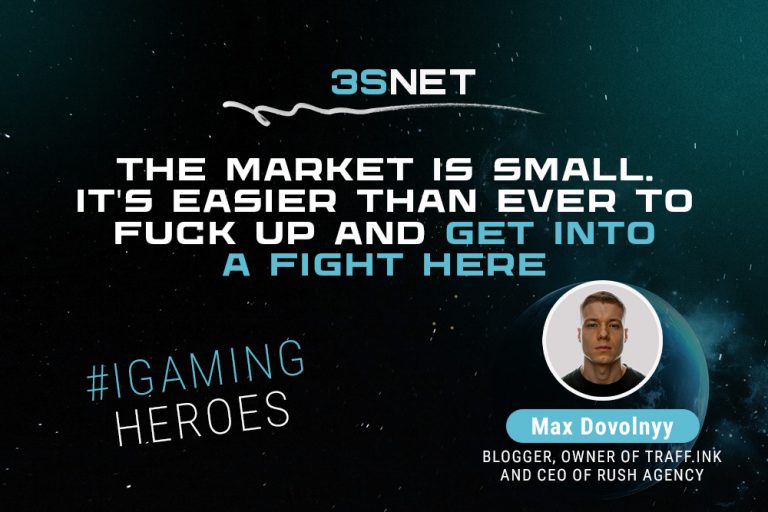
I would not support sensationalist posts that smear competitors, even if they’re paid for and guarantee massive reach. The market is small. It’s easier than ever to f*ck up and get into a fight here. I’ve been in this field for over 10 years, so I’ve had my fair share of hard knocks.
– Media buying and adjacent markets regularly face scams, fraud and high-profile scandals. Is this a problem specific to our industry, or an inevitable growing pain of any market where money and influence appear rapidly? And where, in your opinion, is the line of what’s acceptable?
I think it’s a problem in any industry. If we’re talking about non-payments, shady games, etc., these issues usually stem from a lack of accountability. Many don’t believe in reputation and assume that in a year, everyone will forget about these situations. Generally, that might be true, but I adhere to a different principle: it’s better to lose something in the moment, endure the stress, but exit the game with integrity.
If a product is initially built with intent to scam, that’s also inherent to any niche where fraudulent actions are possible.
Defining boundaries of acceptability is very complex. In my opinion, regardless of the situation you find yourself in, you must maintain transparency with the people you owe. Honestly explain what happened, admit mistakes, promise to fix them, and get to work on solving the problem.
– How do you see the development of media buying and adjacent markets in the next 2–3 years? Where will the main competition be: in traffic, people, technologies, or media?
Many will start preparing the ground in the legitimate sector and diversifying risks. Remember, the era of quick money is over. Everything accumulated needs to work, and it’s better for it to yield less but steadily, than to burn up in the next Facebook* storm.
The main competition will be for people who are capable of taking responsibility and building processes.
– What truly drives you today to keep going? Is it money, scale, interest, influence, or something else?
Undoubtedly, it’s the interest and opportunity to build something new. Money matters too, but so far, I haven’t reached anything particularly substantial yet.
– And at what point would you tell yourself, “Yes, now I’m doing everything right”?
That’s a tough question for me as I’m never satisfied with the result. But I think even now, all decisions were made correctly in one way or another, even if some of them turned out to be wrong.
Keeping your finger on the pulse of iGaming? It’s time to level up and go from pro to legend. We’re swapping tips, breaking down tactics, unpacking insights, and talking about everything that matters. We’re waiting for your contributions!
Don’t want to miss a single important update? The right move is to subscribe to our Telegram channel 3SNET and stay ahead of the curve.
*The Meta Corporation has been recognized as extremist in Russia. The social network Facebook has been blocked in Russia by court order.
Share it with your friends via favorite social media